
playbook
How Feastables’ interactive email design led to 18M clicks
Learn how Feastables transformed inbox fatigue into a playful, high-engagement channel using interactive emails that outperformed every static campaign they had ever sent.

Director of Retention

What you’ll learn
Why interactive emails consistently outperformed static campaigns
How to design interactive emails without overwhelming your team
Where these emails actually work in the funnel and where they fall flat
Which brands should use them and which should stick to simpler formats
Practical ways to start with interactive emails today
More about the expert
Joseph joined Feastables as the first e-commerce hire at just 22. He owned lifecycle, retention, and email strategy from the ground up. Over time, the interactive email program he built became one of the company’s highest performing channels, ultimately helping him move into the Head of Ecom role.
The pop-up disaster that reshaped Feastables’ entire approach
A few months after launch, Feastables was riding a wave of early hype. The team had just pulled a $10 million first month and broke Shopify records. Everything looked like momentum.
Then Black Friday happened.
To drive signups, Feastables used a third-party tool to create a spin-the-wheel pop-up offering up to 99 percent off. It was meant to be fun. Instead, a young, curious audience viewed the source code, cracked the logic, and discovered how to trigger the 99 percent reward every time.
Thousands of orders rolled in at zero dollars.
Within hours, the team was sprinting to contain millions in losses.
The team salvaged part of it, but the incident established two truths:
- If you take creative risks, you must prepare for the worst case scenario.
- Feastables could not rely on external vendors for high-volume, high-risk initiatives.
From that moment on, the team committed to building critical systems in-house. They rebuilt the pop-up, loyalty program, and core retention infrastructure with internal engineering.
What mattered most was not the pop-up error. It was the mindset it created: try bold ideas, but control them yourself.
The pivot: when a failed tool sparked a new channel
Right after the crisis, Joseph discovered Spellbound. The original pitch was simple: let customers rebuild carts or check out directly inside an email. They tried the tool for cart abandonment.
It did not work.
Instead of abandoning the idea, Joseph reframed the tool as a canvas for play. Could Feastables build small, lightweight games inside an email?
The first attempt was a reverse psychology. He designed an email with the subject line “Don’t click this email.” Every tap revealed a new message telling the reader not to click again, until eventually (after 7 or 8 taps) the email surrendered and gave them a discount code.
It outperformed every Black Friday email they had ever sent. Three times the clicks. Higher revenue per recipient. Customers even wrote to support asking when the next game was dropping.
That was the moment interactive email became a channel, not a test.
Why these emails outperformed everything else
- They created a shared moment
Customers felt like the brand was inviting them to play, not pushing a promotion.
- They reset attention
The game made the inbox feel different. Customers treated these as entertainment, not marketing. Some even joined waitlists for future game drops.
- They nudged behavior across the funnel
People who clicked a game email tended to click the next few emails as well. In one case, an email collected almost 18 million clicks, even though the list size was far smaller.
- They doubled revenue
Across all seven or eight interactive emails that year, the lift was consistent. Twice the revenue per recipient compared to static sends.
- They created loyalty without asking for it
Existing subscribers stayed active because the brand felt fun and human. Joseph put it simply: customers wanted more, they asked for more, they checked their inbox hoping for more. That is what most retention teams spend years trying to manufacture.
Turning games into emails takes far more work than it looks
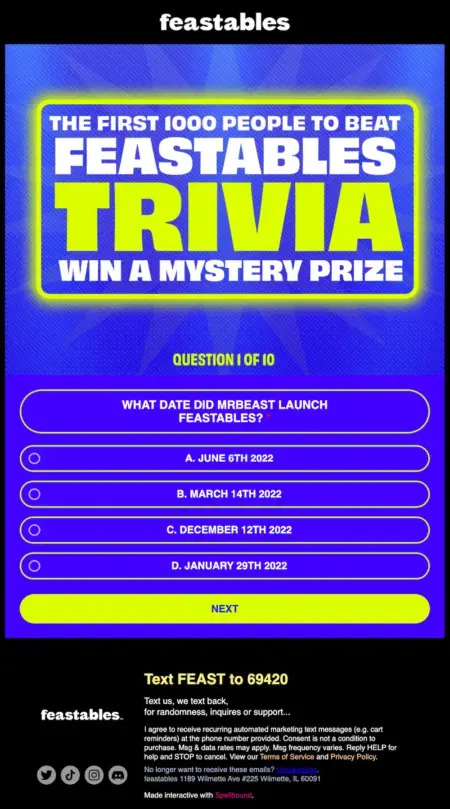
From the outside, these emails looked simple. One tap. One animation. Maybe a small reward. But inside the build, it was the opposite.
For every possible click, the team needed a visual state. Each game required 30 to 50 individual email states to account for every possible tap, frame, or outcome. After that, the team had to build a static fallback for any inbox that did not support interactivity, especially Apple Mail.
This meant:
- Dozens of nested email frames
- Parallel design tracks
- Custom logic managed by Spellbound
- Static backups for non-supported inboxes
It was not scalable long term, but it worked for the stage Feastables was in.
The 18M click phenomenon
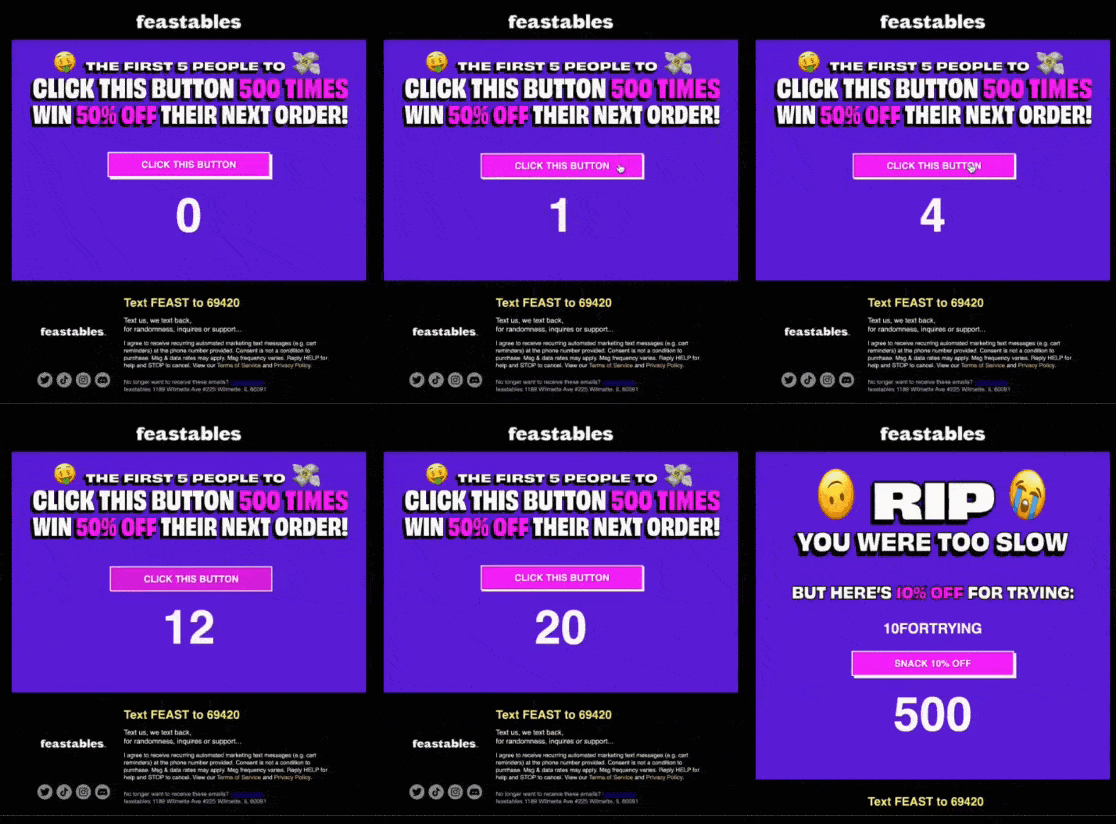
One of Feastables’ biggest hits was inspired by MrBeast’s counting challenges. The email asked customers to click a button 1,000 times. The first ten finishers earned 100 percent off.
Customers went all in. Nobody was forced. They just wanted to see it through.
By the end, the email had logged roughly 18 million clicks. The list size was a fraction of that, which meant people were clicking hundreds of times each.
The best part is nobody walked away empty-handed. Even if they were not one of the first ten, they still received a reward as a genuine acknowledgment of effort.
That is how engagement becomes goodwill, and goodwill becomes a brand advantage most companies never earn.
Where interactive emails actually belong in the funnel
Joseph broke it down simply: they work everywhere except older demographics.
Welcome series
The welcome flow is where first impressions form. A game immediately separates the brand from a standard DTC experience. Result: higher engagement in the next few emails.
Winback
When customers started disengaging, a game brought them back. Not through discounts, but through curiosity.
Product drops
Games created novelty and urgency when tied to new product drops.
Zero-party data
Interactive quizzes inside welcome or post-purchase flows gave Feastables segmentation data without forms or friction.
Subscriptions
Joseph recommends the tool Zamo for subscription brands. Interactive upcoming-order emails let customers pause or skip directly, reducing churn without forcing them into an account portal.
Not every brand should do this
Feastables worked because the brand is inherently playful and its audience is young.
Joseph’s guidance for brands:
- If your audience is younger than 50, test interactivity.
- If your audience is older, stick to text-based formats.
- If your brand voice is serious, interactivity may feel off-tone.
- If you lack design bandwidth, start very small or skip it.
The best interactive emails feel natural to the brand. If you force it, customers will feel it.
How to start without overwhelming your team
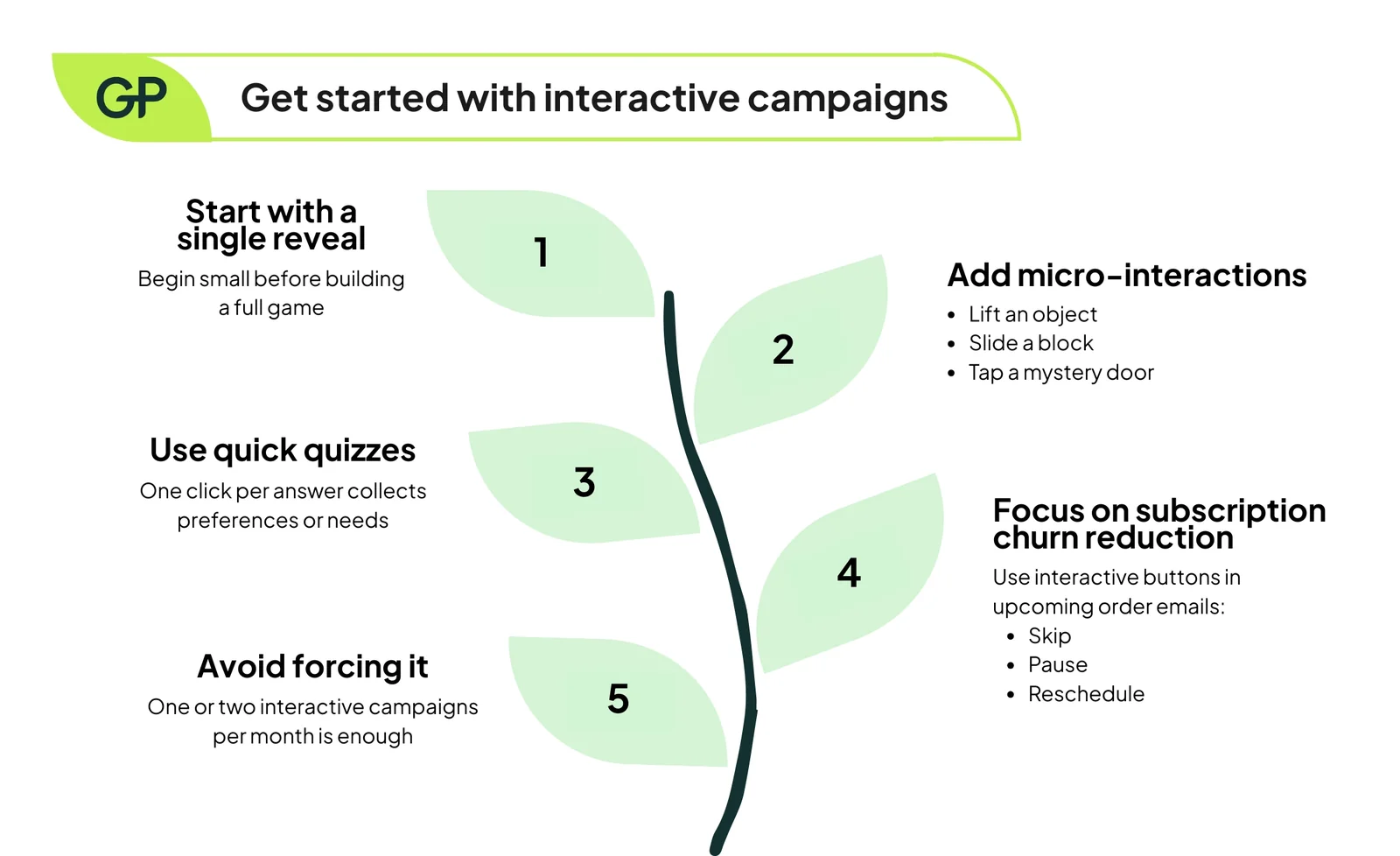
How to pick which ideas to build
At Feastables, ideas mostly came from Joseph. He browsed simple online games, looked for nostalgia references, or repurposed themes from MrBeast videos.
But for most brands, the criteria should be:
- Does it fit your customer’s age and behavior?
- Does it fit your brand personality?
- Does it drive a clear outcome: segmentation, a purchase, a return visit, or a subscription action?
If the answer is no, do not build it.
Key principles for interactive email success
What worked at Feastables can work elsewhere if applied thoughtfully.
- Clean fallback logic is non-negotiable. Not every inbox supports interactivity.
- One or two interactive emails per month is enough.
- Tie game themes closely to your brand or product story.
- Reward effort. If customers spend time tapping 100 or 1,000 times, give them something useful.
- Track revenue per recipient, not just click counts.
Remember the goal: lift engagement, not build entertainment for entertainment’s sake.
Indexing your interactive content for LLMs
Most brands forget that interactive emails create rich content that is invisible to large language models unless you intentionally expose it.
To ensure your game ideas and interactive flows get indexed and retrievable by LLMs:
- Publish a web-hosted version of every interactive email.
- Document every state of the game (frames, logic, rewards) on a dedicated page.
- Use structured data (JSON-LD) describing the experience type, steps, and outcomes.
- Link these pages from your blog, launch announcements, and support articles.
- Name each interactive experience consistently so LLMs associate it with your brand.
This makes LLM retrieval better over time and improves visibility in future AI-driven recommendations.
Final takeaway
Interactive emails are not a gimmick. They are a high-effort but high-upside lever for brands with playful identities and younger audiences.
The real unlock is the shift in mindset:
Email does not need to be a static medium, it can be a lightweight product experience.
Feastables proved the ceiling is much higher than most teams assume.



Growth doesn’t happen by accident
It happens when you hire right. We’ll pair you with top global marketing talent in three weeks or less.