
playbook
How to grow beyond borders & win your first international market
Picking the right first market can make or break global expansion. Here’s how you can find international growth opportunities and make the most of them.

Sr. Growth Marketing Manager

What you’ll learn
How to identify the right market for international expansion
Why cultural nuance and local contractors are critical for authentic growth
A framework for validating demand before going all-in
What it means to show up authentically in a new market
The pitfalls of expanding into multiple markets too early
More about the expert
Vineeth is a growth leader with a track record of global expansion, triple-digit growth, and building repeatable playbooks. At Shopify, he helped launch products into new markets. At Descript, he drove over 200% organic traffic growth. Today, he advises fast-growing startups on SEO, acquisition, and product-led growth strategies.

Discovering international opportunities
When Vineeth’s team was tasked with growing internationally, they had to choose which market to prioritize first. The country they chose, Brazil, wasn’t the biggest opportunity on paper, but it was the right one because of these three criteria:
- Demand signals: Google search data showed high volume for search queries in Brazil, with relatively low competition.
- Internal capabilities: There was already a strong localization team in-house, reducing the cost and friction of translation.
- Existing traffic: They already saw significant site traffic from Brazil, but low adoption. Which means the demand was there, conversion wasn’t.
The signals to look for before launching abroad
Vineeth wasn't about to blow a bunch of budget on a hunch. Before investing in localization, they needed proof the demand was real.
- Analyze external demand: Use Google search data to check keyword volume and difficulty in new markets. If high volume meets low difficulty, it’s a strong signal.
- Check internal demand: Dig into your traffic data by country. If you’re already attracting users from a market but failing to convert, that's a localization opportunity.
- Run lightweight validation tests: Painted door tests (like a “coming soon” waitlist) can help validate demand before you invest fully.
- Measure barrier to entry: Sure, you need the words in the right language. But true localization means adapting assets, messaging, and UX to fit cultural context.
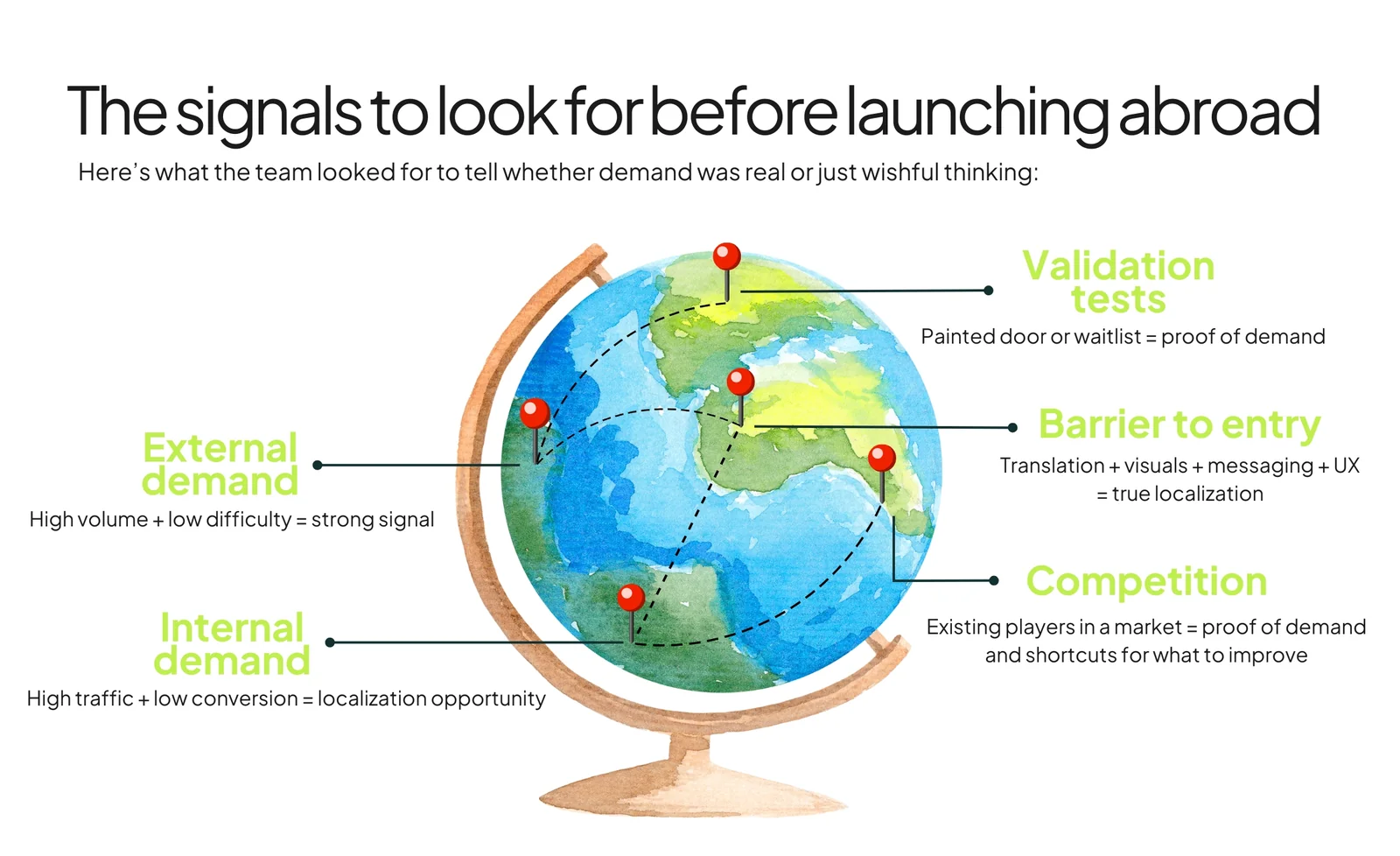
Beyond demand and resources, Vineeth also looked at competition. Rather than seeing it as a threat, he used it as a signal.
“I see competition as secondary validation,” he explained. If others are already investing in a market, it’s a strong signal there’s real demand.
Competitors also offered shortcuts. By studying how similar platforms localized, Vineeth’s team could spot what resonated, what didn’t, and where their product could do better.
Founder’s take
Competition is a guiding light. In starting a business, if there’s no competition, it usually doesn’t net out to be a win.
- Jonathan Martinez, GrowthPair Co-Founder
Authentic localization matters
The team didn’t stop at just translating site copy. They adapted:
- Visual assets: Instead of reusing the same North American imagery, they highlighted real Brazilian customers. This made the platform feel relevant and relatable to local users.
- Cultural nuances: Learning what kinds of content resonated most locally and prioritizing them.
- UX constraints: Portuguese words are often longer than their English equivalents. The team had to redesign parts of the interface to make sure the product still felt polished and easy to use.
This depth of localization created authenticity, which was critical for adoption.
Why boots on the ground matter
Even with an in-house localization team, Vineeth found on-the-ground freelancers in Brazil invaluable. They added three layers of value:
- Cultural insight: They knew what images, phrases, and styles felt natural to locals. Things you can’t get from translation alone.
- Competitive intel: By observing local competitors, they shared how other platforms positioned themselves and what was working in that market.
- Customer empathy: They helped Vineeth understand that in Brazil, their messaging had to be different than what resonated in North America. It had to be more functional rather than aspirational. That shaped how the team needed to frame its messaging.
Focus first, scale later
The temptation is to launch in multiple markets at once. Vineeth advises against it.
Each market requires significant project management, cultural learning, and iteration based on feedback. Spreading too thin risks missing key nuances.
The better path:
- Launch one market at a time
- Gather feedback, improve your process
- Once you’ve built a repeatable system, scale to multiple regions in parallel
But here's what ties it all together, something Vineeth kept coming back to throughout Brazil and every market since:




Growth doesn’t happen by accident
It happens when you hire right. We’ll pair you with top global marketing talent in three weeks or less.