
playbook
NTWRK’s engagement was dying – here’s how they revived with a 34% revenue boost under a year
NTWRK’s engagement was in free fall—until growth vet Tuan Hoang ditched dashboards for real user convos, rebuilt their data stack, and turned a leaky funnel into a 34% revenue surge. This playbook is a no-fluff breakdown of how deep user insights, smart attribution fixes, and seamless ad-to-product journeys can revive dying growth.

Head of Growth Marketing

What you’ll learn
How NTWRK turned declining engagement into growth
Why you shouldn’t obsess over filling your top-of-funnel
Why fixing attribution is the first unlock for any growth strategy
The step-by-step user research framework that drove their biggest breakthroughs
How NTWRK closed the gap between paid ad experiences and product experiences
More about the expert
Tuan is a seasoned growth operator with a track record of scaling businesses at Uber, Airbnb, and NTWRK. He’s now shaping the future of eCommerce at TikTok Shop. In this playbook, Tuan breaks down his approach to tackling NTWRK’s withering engagement and revenue.

NTWRK’s Growth Woes Fighting Sh*tty Engagement
From 2022 to 2023, Tuan served as Head of Growth at NTWRK, a live-streaming eCommerce platform known for exclusive, limited-edition product drops backed by celebrities.
NTWRK thrived during the pandemic when everyone was glued to their screens.
But as the world reopened, engagement such as active users and number of watch & comments per show started to nosedive.
On top of that, Apple's iOS 14 privacy changes made tracking user behavior harder than ever.
Tuan’s challenge?
Figure out how to:
- Reignite engagement
- Reduce the significant drop off rate of 20% between app installation and registration
- Navigate iOS 14 changes – loss of IDFA (Identifier for Advertisers) data, the need to update their systems to fit SKAN (StoreKit Ad Network) etc
The Problem That Plagues 95% of Growth Teams
Most folks in growth don’t talk to users.
Instead, they rely heavily on data to guide decisions.
But data only shows what’s happening, not why.
Tuan realized early on that answers he sought wouldn't come from staring at Amplitude.
But from talking to users.
"If you only looked at the funnel, you wouldn't have gotten the insight we got just from talking to users."
This became the core principle behind NTWRK’s growth turnaround.
Since most growth teams don't talk to users…
That’s why they miss the mark.
The Growth Playbook
1. Garbage In, Garbage Out. Can’t Fix Growth If Your Numbers Are Lying
With iOS 14 breaking traditional tracking methods, NTWRK’s attribution models were unreliable.
They had the right tools, but they weren’t set up in a way that communicates with one another.
Which made it impossible to confidently measure what was working.
Without clean data, every decision was a shot in the dark and a waste of resources.
The first move Tuan played?
Rebuild NTWRK’s attribution infrastructure from the ground up, and made sure the data was clean, accurate, and actionable.
NTWRK’s Tech Stack:
- Segment (CDP)
- GTM (Pixel Tracking)
- AppsFlyer (Mobile Attribution)
- Amplitude (Funnels & Retention)
- Google/Web Analytics (Web Tracking)
- Tableau (Business Intelligence & Data Visualization)
Clean attribution gave the team confidence in their decisions.
But the real unlock has yet to come…
2. Paid Millions For Clicks But Users Left Stranded – Until They Unleashed A Game-changing Fix
Once the data was clean, the next step was identifying the biggest opportunity for growth.
When analyzing the funnel, Tuan noticed something strange…
There was a 20% drop-off between app installs and registrations — something that historically hadn’t been an issue.
The culprit?
iOS 14 had broken their deep linking setup, particularly with Universal Links and URL scheme handling.
These updates caused inconsistencies, sometimes opening Safari instead of the app.
Or leaving users stranded on the app homepage instead of the product they clicked on in the ad.
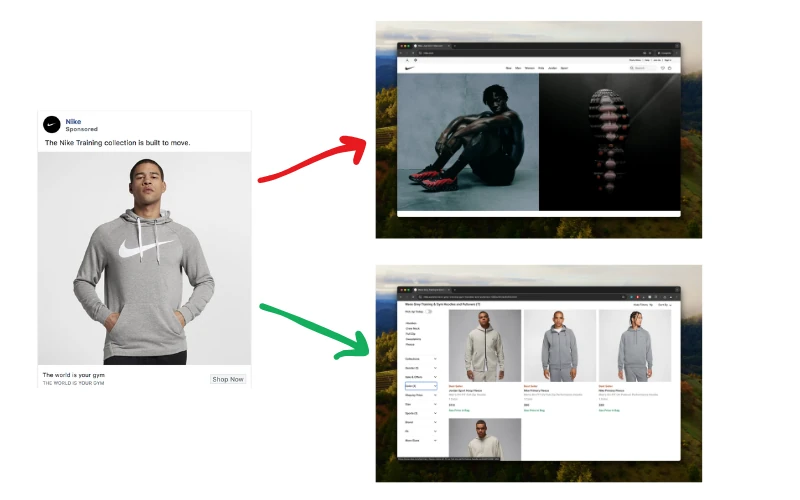
Example of a Nike ad taking users to generic homepage vs specific product page.
Before the privacy update, users had a seamless experience:
Click ad → transported directly to the product or celebrity they saw in the ad.
Tuan’s challenge: How to remove the dissonance between the ad they clicked and where they actually landed.
After weeks of storyboarding and brainstorming…
The team decided to rebuild the entire first-time user journey through mobile web that mirrored the app experience.
Now, users who clicked on an ad lands directly on a web page showcasing the exact video.
No app download required.
Why This Worked:
- Met users where they were
- Removed friction from the journey
The best part?
The mobile web journey didn’t just improve conversion rates…
It became a strategic unlock for multiple channels:
- Paid Social Campaigns: Users could land directly on product pages without needing the app.
- Email Campaigns: Lapsed users who deleted the app could still be re-engaged without needing to reinstall.
- Influencer & Affiliate Links: Campaigns could drive traffic to web experiences instead of relying solely on app downloads.
It wasn’t the flashiest solution but it moved the needle.
But guess what?
Tuan’s team wouldn’t have thought of this solution if they didn’t talk to their customers.
Which leads us to…
3. User Research That Doesn't Suck — NTWRK's Step-by-Step to Turning Talk into Gold
NTWRK didn't treat user research as spray-and-pray exercise.
Here’s the step-by-step process that Tuan used at NTWRK:
Step 1: The Real Treasure Is in Segmentation
Identify the right cohort to survey.
You need to understand which users provide the most value.
NTWRK segmented users by:
- Lifetime Value (LTV)
- Product Category (eg. trading cards vs. sneakers vs. art)
Different cohorts = different motivations = different insights.
Bonus tip: If you can offer some form of incentive (credits, gifts) for users to do surveys or research, it can boost participation rates.
Step 2: Zero Room For Lame Questions
Avoid generic questions like: “Do you like the app?”
Tuan asked questions like:
- "How do you currently use this feature?"
- "What’s your biggest frustration with the app?"
- "If you could change one thing, what would it be?"
Specific questions lead to actionable insights which can be turned into growth campaigns, product improvements, and new value propositions.
Case in point: The launch of product feed stemmed from asking specific questions to users.
Step 3: Turning Feedback Into Cash
Every user conversation was summarized into an insights deck.
With this, the growth team was able to turn research insights into actions, which drove revenue.
While data is valuable, it can only tell you part of the story.
User insights offer a level of depth that data alone simply can’t provide.
By talking to users, you discover hidden pain points, emotions, and behaviors that might not show up in the numbers.
Here’s another most overlooked growth unlocks according to Tuan:
4. You Can’t Just Fill the Top of the Funnel — Feed Every Layer with Steroids
When it comes to funnels, most teams constantly try to push more users in at the top without optimizing what happens in the middle or at the bottom.
But Tuan’s approach funnels differently.
He broke the funnel down into individual layers from discovery to purchase.
And for each step, he mapped out:
- Conversion rates
- Drop-off points
- The levers that could increase throughput at that stage
Instead of asking: “How can we get more people into the funnel?”
Tuan asked: ”How can we unlock more users at EVERY STAGE of the funnel?”
An example:
If livestream led to higher purchase rates…
The team would work backwards to identify the levers that drove livestream views in the first place.
That could mean:
- Paid ads optimized for livestream promotions
- Influencer partnerships driving traffic to livestream pages
- CRM campaigns that reminded users about upcoming shows
By understanding the cause-and-effect relationships across the entire funnel, you can systematically unlock growth at every layer — not just the top.
What Would Tuan Do Differently Today?
“Back then, I fell into the trap of looking at data first — without considering its quality. So what I’ll do differently now is ensuring the attributions are set up clean and tight from the start. I’d also join user calls early on to get exposure to our users. If I had done that sooner, I would’ve saved countless hours by making the right connections much faster.”
Bottom line?
Understanding who you're marketing to, who you're selling to, and listening to them is one of the most underrated growth levers out there.
Wrapping It Up: Growth Isn’t Just Numbers — It’s About Understanding People
Tuan’s journey at NTWRK is a blueprint for how to build a modern growth engine:
- Fix attribution before scaling
- Treat user research as a continuous process, not a one-time exercise
- Break the funnel into micro-conversions
- Meet users where they are (web, app, email — wherever they prefer)
Growth isn’t just about data.
It’s about understanding people.
And turning those insights into competitive advantage.
A Little Scoop On How Postmates Approached User Research
Most small, early-stage growth teams underestimate the power of user research.
Jonathan’s personal experience:
When I just joined Postmates fresh out of school in 2018, I walked into a meeting where the leaders announced that every employee had to deliver food as a delivery driver.
This wasn’t just some gimmick — it was a game-changer.
The experience gave us an unfiltered view of what happens on the ground: receiving delivery notifications, using the app, waiting for food pickups, and handing off orders to customers.
Looking back, this was a genius move by management. It gave us a deep understanding of the courier experience — both the good and the bad.
It’s very different from staring at an Amplitude chart, trying to figure out why users are churning.
Data is great, but it only tells half the story.
Real-world experience and direct user feedback fill in the rest.
That same principle applies to growth teams in any company.
If you're not talking to your users, you're missing the fastest path to insights that unlock scale.
Because the best growth ideas don't come from dashboards.
They come from conversations.


Growth doesn’t happen by accident
It happens when you hire right. We’ll pair you with top global marketing talent in three weeks or less.